Saturday, 22 August 2020

Praudadevaraya Most Powerful Emporer of Vijayanagar Empire


Praudadevaraya was the greatest ruler of the Sangama Dynasty of Vijaynagar empire. He was the first king of Vijaynagar empire who conquer Ceylon. He ruled 1426- 1446 . He was also called Devaraya II . He took the title GAJABETAGARA means an expert in haunting the elephant.

He wrote the famous Mahanatka Sudhanidhi , a text on music. During his time Kannada literature developed so much. His literary assembly was called Mutyalasla (Palace of Pearls). He conferred the title emperor of poets (KAVISARVABHAUMA) upon Sreenath.

He employed Muslims to train the Vijaynagar cavalry . He also constructed a mosque for Muslims at Humpi .

Who is the greatest king of the Vijayanagara Kingdom?

Many consider Krishnadevaraya as the greatest king of Vijayanagara empire who ruled between 1509-1529 . For he conquered many lands and for his administration capability .

But he left the kingdom more weaker than it probably was by not appointing a proper and capable heir after his death and most of his later days was filled with many defeats and he went into a Depression after the death of his Son and sent his close aid whome he considerd a father figure to dungeon/prison where his eyes were plucked . Leaving the administration in the hands of his son in law Rama raya. Krishnadevaraya died with complete depression and a sense of regret.

Though Aliya Rama Raya was a shrewd adminstrator and capable ruler but his cunningness lead to Bahamani kingdom who were devided to unite and battle against Vijaynagara kingdom which lead to 1556 battle of rakkasa tangadi in raichur destrict ,karnataka. Where Vijaynagara kingdom was anniahalated.

So I would say Prauda devaraya /Deva raya 2 to be the greatest king of Vijayanagara empire.

Deva Raya II (r. 1425–1446 CE)

he was an able administrator, an ambitious warrior and a man of letters. To him goes the credit of authoring well-known works in the  (Sobagina Sone and Amaruka) and in the (Mahanataka Sudhanidhi)

Some of the most noted Kannada poets of the medieval period, such as  and  gained his patronage.

According to the historian Sastri, Deva Raya II had the kannada title Gajabetegara, which literally means "Hunter of elephants", an honorific that explained his addiction to hunting elephants or a metaphor referring to his victories against enemies who were "as strong as elephants".

Deva Raya II extended and held territories up to the Krishna river. According to an account of visiting Persian chronicler , Deva Raya II's empire extended from  to , and  to the . According to the historians Chopra, Ravindran and Subrahmaniyan, the king maintained a fleet of ships which helped him in his overseas connections.

It was during this time that the explorer Nicolo Conti and Persian chronicler Abdur Razzak arrived in South India. Conti wrote :"the king of Vijayanagar is more powerful than all the other kings in India."

Razzak wrote :"the ear of intelligence had never been informed that there existed anything equal to Vijayanagara in the world and the pupil of eye has never seen a place like it" (on an interesting side note the two explorers also commented on Deva Raya II's large harem in which 4000 queens followed him everywhere he went). Razzaq who was also an ambassador at the court of Deva Raya II wrote:"This prince has in his dominions three hundred ports, each of which is equal to  and his territories compromise a space of three months journey.

Both travelers concur that the country was thickly populated with numerous towns and villages. Razzaq wrote:". The troops amount in number to Eleven lakhs (1,100,000)." Razzaq considered Vijayanagara to be one of the most splendid of the cities in the world he had seen.

Describing the city, he wrote: "It is built in such a manner that seven citadels and the same number of walls enclose each other. The seventh fortress, which is placed in the center of the others, occupy an area ten times larger than the market place of the city of Herat".

With regards to the market places he wrote:"the jewelers sell publicly in the baazar pearls, rubies, emeralds and diamonds in this agreeable locality and in the king's palace one sees numerous running streams and canals formed of chiseled stone, polished and smooth


Wednesday, 19 August 2020

OpinionMacaulay Is Very Relevant Today and Helps Dalits, OBCs Join the Global Economy Education


OpinionMacaulay Is Very Relevant Today and Helps Dalits, OBCs Join the Global Economy Education

The new education policy’s proposal to reduce the importance of English in schools will hinder progress.

Jul 31, 2020 | Kancha Ilaiah Shepherd

Thomas Babington Macaulay. Credit: Wikimedia Commons/Public DomainThomas Babington Macaulay. Credit: Wikimedia Commons/Public DomainThomas Babington Macaulay (1800-1859) lived in India just for four years, from 1834 to 1838. Yet he left unerasable footprints on Indian soil. During his time in India, he decided to introduce English into the education of Indians by deploying government resources in schools and colleges. He argued that Sanskrit and Persian, which were the medium of instruction under the East India Company before the British Crown took over the Indian administration, should be done away with from schools.Today, many English-educated Indians deride Macaulay, perhaps for giving that language to them and what they also call the ‘un-Indian’ English culture. Only very few who are also English-educated admire him occasionally. Those who criticise Macaulay come from all schools of thought: extreme right, extreme left and centrist liberals.But vast numbers of Indians who are outside the English-speaking milieu – food producers, such as the Shudra, Dalits and Adivasis, who work in the fields – do not think about Macaulay. For them, their local languages – Hindi, Tamil, Telugu, Malayalam, Bengali, Marathi, Gujarathi or tribal languages and so on – are the medium of instruction in schools and colleges. The English language, with its global accessibility, is too far away from them. Yet, Macaulay also has admirers among Dalits and OBCs who feel that English is a language of liberation and have taken to it as a way of progressing in life and in their careers.Now, with the new National Education Policy somewhat demoting the status of English by giving a priority to Indian languages for the first few years of school education, the issue becomes pertinent. Are Macaulay and his ideas irrelevant and un-Indian? Is Macaulay’s presence fine in private English medium schools but not good for government-run schools, where the poor children study?More in Politics :Watch | 'Senior Facebook Execs Associated Themselves With Modi Even Before BJP's Victory in 2014'Facebook Employees Internally Question Policy Over Ankhi Das Controversy in India10 Fewer State Information Commissions Functioned During Unlock 2.0 in July'Affirm Right to Express Dissent,' Say Eminent Citizens on Eve of Prashant Bhushan's SentencingRestricting Access to Defence Audit Reports and the Need for Greater Public DebateSwiggy Delivery Executives Strike in Chennai and Hyderabad Over Reduction in PaymentQuite consciously, from the days of Jawaharlal Nehru, the so-called ‘anti-national Macaulay’ English education has been confined to expensive private schools, where only very rich Dwijas could afford to educate their children. Even rich Shudra landed gentry did not send their children to good English medium schools. Many Dwijas, in fact, preferred to send their children to Christian missionary schools.Both Macaulay’s detractors and admirers are able to speak and write in the English language; they were educated either in Indian English medium schools, colleges, universities or institutions like IITs and IIMs or foreign universities.Six months into its tenure, the Kamal Nath government has held agriculture above all else. It now needs to focus on health and education. Representative image of schoolchildren. Credit: PTIRepresentative Image. Photo: PTIWhat was the state of education before Macaulay?There was hardly any modern college that used Sanskrit and Persian as the medium of education until 1834. Anyway, education in Sanskrit and Persian was meant for the Hindu Dwijas (Brahmin, Bania, Ksatriya, Kayastha and Khatris) and Muslim feudal lords, who perhaps were either Pathans or Arabs or Dwijas who converted.Unlike the Christians, Muslims never allowed the non-Muslim Shudras and Dalits into their schools. Some Dwijas – mainly Brahmins – managed the system of education in Persian, in collaboration with rich Muslims. But that did not help them with employment, even when it was the official language, because the bureaucracy and legal systems were dominated by Brahmins.School education in these languages was not available to Shudras, Dalits and Adivasis of India, who were the main food producers then, as they are now.Actually the earliest missionary teaching of the English language to Dwija children was started in 1817, as a private affair, by William Carey (1761-1834) in association with Rajarammohan Roy in Culcutta. He came to India in 1793 and died here in 1834, the year in which Macaulay arrived. Carey established the Serampore College in 1818, the region’s first degree college in the English language. Which caste and class of youth were able to access this college? Would it have been Bengali Shudras and Namashudras? No way.Also Read: Language Policy: Education in English Must Not Be the Prerogative of Only the ElitesWhat Macaulay proposed to the British administration was to make English part of the state education policy to replace Sanskrit and Persian. While Indian Muslim feudal lords refused to send their children to English medium schools at the cost of their Persian and Urdu education, the Brahmins of Bengal and Kerala had no such inhibitions. They were among the earliest to do so, setting aside Sanskrit education.Dwija Hindus wanted to become pleaders, officials and clerks in the government offices as ‘middlemen’ (not many women were allowed to hold these positions then) between the British colonial rulers and the Indian Shudra-Atishudra masses.The term Shudra-Atishudra was first used by Mahatma Jotirao Phule, the first Shudra person to be educated in the English language. In the Bengal region, whether any Shudra or Namashudra was allowed to go to school – leave alone one with English as the medium – is not known. In Maharastra, where Phule and Dr B.R. Ambedkar came from Marathi and English education, which was accessible to some Shudra and Dalit social forces in subsequent years. But in Bengal, it still remains a Bhadralok preserve. From Rajarammohan Roy to Jyothi Basu to Mamata Banerjee, English and thus power, are in their hands only.Busts of Mahatma and Jyotiba Phule.Why is Macaulay important?Why is Macaulay dear to the Shudras, Dalits and Adivasis now? The Indian state and civil society have to move towards a mode of education that imparts global and Indian knowledge – even within the framework of competing nationalisms – to all children in the English language.It is also important to remember that the ideological attack on Macaulay did not lead to a total divorce from the English language. Among the ruling classes, whatever is their ideological and political position, their children are educated in English medium schools.But quite consciously, this language has been kept away from the rural agrarian, productive masses. This has led to the creation of two nations—English-speaking India and mother tongue-speaking Bharat. A small number of English-educated Indians, in this globalised world, have taken the lead in every sphere of life. The rural masses cannot catch up with the globalised, English-educated Indian ruling and business classes unless they too acquire that language, right from their time in school.From tribal areas to our metropolitan urban centres, Indian school and college education has to be in one common language, with the same content and course levels. Unless all children do not read and write one national and international language – English – the creation of a national, advanced intellectual discourse will not be possible. Even the production of new scientific knowledge is linked to a globally communicable language. Teaching children science in their mother tongue is not going to help.‘Will alienate people from Indian culture’The common argument that English medium education will alienate people from Indian culture has proved to be deceptive propaganda. The Shudras, Dalits and Adivasis have had a very bad experience with the ‘divine distancing’ of Sanskrit, which was the ‘national language’ in ancient and medieval times, from their lives. The agrarian masses have been deceived on the issue of language for quite a long time. Now these same forces are trying to deceive these productive masses by keeping their children away from English, by labelling it Macaulay’s “colonial conspiracy”.Andhra Pradesh chief minister Y.S. Jagan Mohan Reddy has broken the myth that Macaulay’s English is anti-national or un-Indian. He has decided to introduce English as the medium of instruction in all government schools. When the same Macaulayputras tried to oppose it, the rural productive masses responded by saying, “You hypocrites, send your children to Sanskrit medium schools, but our children need to study in English.”The diabolical nature of Hindutva is all around us. A time has come to abolish the two-language nation – one English speaking and the other in their mother tongue – and see that all Indians speak and write only in English. Regional languages can be used for local purposes. Macaulay and his ideas have to be re-evaluated in light of the modern world.Kancha Ilaiah Shepherd is a political theorist, social activist and author.

Whatsapp sharefacebook sharetweet buttonNative Share
Get the latest news, top headlines, opinions, analysis and much more from India and World including current news headlines on elections, politics, economy, business, science, culture on The Wire.
- POWERED BY -
Readwhere CMS

Tuesday, 18 August 2020

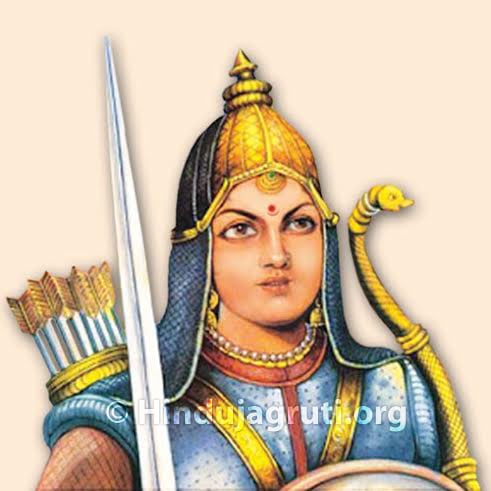
Rani Durgavati

Great Hindu Warrior Queen : Rani Durgavati of Gondwana


Many people would know about the story of Rani Padmini/Padmavati who committed Jauhar(self-immolation) in order to save her honor. But few people know about the bravery and never give up spirit of the 16th century Empress who not only challenged authority of the Mughals but Defeated the Muzaffarid dynasty ruler  Baz Bahadur , who reigned over the Gujarat Sultanate. 

Born in the Chandel dynasty of the Rajput clan Durgavati was the daughter of Keerat Rai, the ruler of Kalinjar(Uttar Pradesh). The Chandel’s were famous for repulsing the invasion of Mahmud of Ghazni. So it’s no surprise the valor and courage of the Indian queen was in her blood.  Growing up in Kalinjar she was well versed in Horse riding, Sword Fighting and Archery from a very young age. Various references talk about her hobby of hunting. She always had a zeal of learning and followed her Father in the matters of Politics, Governance and Warfare. However the glorious reign of Chandel’s was declining as they were confined to Kalinjar.

Durgavati was married to Dalpat Shah the eldest son of Gond king Sangram Shah. Gonds were tribe who setlled in Gondwana(Eastern Madhya Pradesh) They ruled 4 kingdoms Garha-Mandala, Deogarh, Chanda and Kherladurgavati 1

Durgavati’s Marriage to Dalpat Shah was an unconventional one as there was rarely marriage alliance between Chandel’s and Gond. Some Sources also suggest a folk tale about a hunting incident where Princess Durgavati killed a lion while piercing her arrow in the Lion’s heart, The Gond Prince Dalpat Shah who himself was hunting in the jungle that day witnessed bravery of  the princess and lost his heart her, a marriage proposal was later sent to Keerat Rai who despite reservations for the marriage agreed.

The Chandel’s were in continuous war with the Kalchuri’s  near Jabalpur and the Later Delhi Sultans which continued to drain their treasures. The marriage was a would give the Chandel’s new allies with the Gond’s who had considerable wealth and hence the marriage alliance was formed between the two kingdoms. This proved fruitful when Keerat Rai gave Stiff Resistance to Sher Shah Suri who attacked Kalinjar in 1545 C.E.  Later Durgavati’s father died and the Mughal emperor Akbar became the emperor on Mahoba and Kalinger.   

maxresdefault

In 1545 C.E Durgvati gave birth to a son who was named Vir Narayan, however Dalpat Shah passed away in 1550 C.E leaving behind his minor son and Queen. This did not deter the Queen’s Resilience she was not deterred and became the Regent of Gondwana. She made Vir Narayan the new king of the Gonds and took over the Reign of Gondwana.  Diwan Beohar Adhar Simha and Minister Man Thakur helped the Rani in looking after the administration successfully and effectively. Rani moved her capital to Chauragarh in place of Singaurgarh. It was a fort of strategic importance situated on the Satpura hill range. 

Looking at this opportunity to expand his empire  Miyan Bayezid Baz Bahadur Khan the last sultan of Malwa declared war against Gond’s in 1556. This however turned out to be a foolish move by him as his army suffered heavy losses and he had to flee from the battlefield. The Queen hence established herself as the rightful and a powerful person to the throne and gained loads of fame in her kingdom.

Peace remained in her territory for the next 5 years. After his Northern conquest when Akbar The Mughal King turned his attention to Deccan. He defeated the army of Baz Bahadur who fled after the battle. He was aware about the valor and Courage of Rani Durgavati as written in Akbarnama by his court Poet Abul Fazl who states “She was not lacking any of the essentials of bravery and of effort, and did great things by dint of her farseeing abilities. She had great contests with Baz Bahadur (of Malwa) and the Minas (Afghans of Sironj in Malwa) and was always victorious…. She was a good shot with gun and arrow, and continually went hunting. The wealth of  Garha-Mandal was so much that they traded in elephant or gold in their market ’’

Knowing the wealth and zeal of the Queen Akbar sent his best General, Khwaja Abdul Majid Asaf Khan, an ambitious man who vanquished Ramchandra, the ruler of Rewa. Prosperity of Rani Durgavati’s state lured him and he invaded Rani’s state. 

When Rani heard about the attack by Asaf Khan she decided to defend her kingdom with all her might although her Diwan Beohar Adhar Simha pointed out the strength of Mughal forces. Rani maintained that it was better to die respectfully than to live a disgraceful life she said to her solidier “It is good to die in a good condition rather than live a tarnished life. It is a matter of shame to bow in front of ordinary subedar like Asaf Khan.”

Print

The queen dressed like a soldier’s ascended her horse. Asaf Khan’s senses were seen leaving when he saw the queen leading charge on her horse.The Queen’s soldiers in the battlefield were exuberant and they started cutting their enemies into half. The queen also broke down on the enemy just like the Hindu “Goddess Durga” . 

To fight a defensive battle, she went to Narrai, situated between a hilly range on one side and two rivers Gaur and Narmada on the other side. It was an unequal battle with trained soldiers and modern weapons in multitude on one side and a few trained soldiers with old weapons on the other side. Her Faujdar Arjun Das was killed in the battle and Rani decided to lead the defence herself. As the enemy entered the valley, soldiers of Rani attacked them. Both sides lost some men but Rani was victorious in this battle. She chased the Mughals out of the valley The wrath of the queen made Asaf Khan flee  and he succeeded in saving his life with great difficulty.

rani-durgawati-002-1498197236_835x547

Hearing about the Inflicting loss of the Mughals in the battlefield, a few days later  a great number of reinforcement along with big guns and cannons for the battlewere sent. Asaf Khan was again made the general to lay siege. He attacked again The queen was operating the army aboard the elephant. They cut the heads of Mughal artillery. Seeing this, the army of Asaf Khan retreated twice, Asaf Khan was full of shame and gloom and he decided to attack with all his might and lay siege to the fort for the third time to avenge his defeat next day. (It is allegedly said Khan was helped by a treachrous noble of Rani Durgavati.)

At this stage Rani reviewed her strategy with her counselors. She wanted to attack the enemy at night as they had superior weapons, numerical strength and a large cavalry this time. She wanted to enfeeble them but her lieutenants did not accept her suggestion as it was the tradition of the Rajput’s to fight after sunrise and Either to come back victorious or die trying.Therefore the lieutenants refused to compromise the traditional warfare rules just for the sake of victory unlike their Mughal counterpart who often fled away to fight another day.  

While few agreed with the Rani’s decision to attack at dawn, Rani rode on her elephant Sarman came for the battle. Her son Vir Narayan also accompanied her in the battle.

rani-durgavatiThey laid havoc on  the Mughal army but durthe war Vir Narayan got wounded and had to retire to a safe place along with some nobles. Seeing the condition of her brave son, the queen started throwing swords on her enemies with double thrill, she cut the heads of the enemies and they started to fall on the ground. In the course of battle Rani also got injured badly. She succumbed injury near her ear with an arrow. Another arrow pierced her neck and she lost her consciousness. On regaining consciousness she perceived that defeat was imminent. Her mahout advised her to leave the battlefield but instead of accepting defeat or getting captured by the enemies she took out her dagger and killed herself. After her death her son tried to defend the kingdom from their capital at Chauragarh fort but he too died fighting.

The Kshatriya Veerangana is a source of inspiration to all women. Her courage, zeal to fight for her motherland from invaders continues to thrive. A great example of women power she really defied the odds in the era dominated by the men to inspire to fight for a cause, live and die for honor. Many folklore’s are still sung in Madhya Pradesh in her name She is remembered as the Queen who defied the odds to become immortal in history.

William Sleeman in his Rambles and Recollection of an Indian Official, writes, ‘Her tomb is still to be seen where she fell, in a narrow defile between the hills; and a pair of large rounded stones which stand near are, according to popular belief, her royal drums…. The travellers who pass this solitary spot respectfully place upon the tomb the prettiest specimens they can find of crystals…. Durgawati so inspired me that I could not resist the temptation of adding one to the number when I visited.’

Her martyrdom day (24th June 1564) is even today commemorated as “Balidan Diwas”

   VISHWA LALIT


Friday, 7 August 2020

The Holkars of Indore-Malhar Rao Holkars

History Under Your Feet


“Two pearls have been dissolved, 27 gold coins have been lost and of the silver and copper the total cannot be cast up”- Message to Balaji Baji Rao after Panipat

The 3rd Battle of Panipat, had dealt one of the worst blows ever to the Maratha empire, Balaji Baji Rao, the Peshwa, could not recover from the debacle and died broken hearted in the very city of Pune, that he so lovingly built.  The Marathas lost the entire Northern territories of India from Delhi onwards, and the empire ran up into huge debts. It was at such a critical juncture that Madhavrao I, became the Peshwa on June 23, 1761, at a very young age of 16. Due to his rather young age, his uncle Raghunathrao was appointed as his regent to assist him in the administrative affairs.  Madhavrao I managed to bring the administration back into track,  and also secured the treasury that was being looted.  He had the unenviable task of rebuilding the Maratha Empire that had suffered a body blow, after Panipat and setting right the rot in the administration.  Madhavrao I’s reign however  would be remembered for the creation of the semi autonomous Maratha states in the Deccan and the North, it was a tactical decision to keep the Maratha empire intact.

While the Peshwas ruled over Pune, in the Western part of India, Pilaji Rao Gaekwad captured Baroda from the Mughals in 1721, leading to the establishment of the Gaekwad dynasty there. The Peshwa authority by now had considerably eroded post Panipat, and the semi autonomous dynasties like the Gaekwads began to assert themselves even more. In Central India, Ranoji Scindia, a patil from Satara district, commanded the Maratha invasion of Malwa, under Peshwa Baji Rao and became subedar of the province in 1736. He established his own capital at Ujjain in 1731, and later in 1810 moved to Gwalior, which would be the seat of the Scindia dynasty. In Maharasthra itself, the Bhonsle’s established semi autonomous fiefs at Nagpur, Satara and Kolhapur, while smaller semi autonomous provinces like Dhar, Sangli, Aundh etc sprang up.

Malhar Rao Holkar I.jpg

Malhar Rao Holkar

The Holkars were technically not Marathas, they were primarily Dhangars, a community of shepherds and cattle herders , predominantly found in Maharashtra. It is believed they were originally from Gokul near Mathura, and later migrated into Mewar, from where they spread into Gujarat and Maharashtra. They were known for their poetry called Ovi, which was inspired by the pastures and forests where their flocks grazed. Their patron deity was Biroba, a form of Lord Shiva, and the Dhangari Gaja dance in his honor is pretty well known.

Khandoba Temple of Jejuri

Khandoba Temple of Jejuri


In the village of Hol, close to Jejuri( now in Pune district), Malhar Rao Holkar was born, in 1693. Growing up at Taloda(now in Nandurbar dt), he belonged to the Raj Pali   clan of the Dhangars, a form of Royal Shepherd, one of the higher rated clans. One of his wives was Bana Bai Sahib Holkar, a Khanda Rani, so called, as he had sent his sword to represent him at their wedding, due to her status as a Rajput princess.

Like most others, Malhar Rao Holkar served for some time under the local Sardar, Kadam Bande, and took part in the military campaigns of Peshwa Balaji Vishwanath in 1719. Post Aurangzeb’s death in 1707, the Mughal empire started to slide into decline, and the actual power remained with the Sayyid brothers, Hussain Ali Khan and Abdullah Ali Khan, the so called king makers.  Hussain Ali Khan, weary of the constant Maratha attacks in the Deccan, sought to make peace with them, and in 1718, Balaji negotiated a treaty with them, by which the Marathas would have the right to chauth and sardeshmukhi in the old Mughal provinces of the Deccan. As well as Gujarat, Khandesh and returning Shivaji’s Maharaj’s territories in Karnataka.   Farrkukhshiyar, the Mughal emperor refused to ratify the treaty, and attempted to get rid of the Sayyid brothers, who however having got wind of the news, organized a rebellion along with the Marathas.

Rajwada Palace, Indore.jpg

Rajwada Palace Indore.


Foundation of Indore State

Indore was initially a part of the Kampel pargana during the Mughal empire, under the Malwa Subah and administered from Ujjain. It was first developed by zamindar Rao Nand Lal Chaudhary and was believed to have got it’s name from the Lord Indreshwar Temple there. Nandlal was quite influential during the Mughal reign, and was given sanads by both Aurangzeb and later Farrukshiyar, as well as a special gold Langar from his friend Jai Singh II.  The modern day settlement was founded during the mid 1710s, when Nandlal built the Sree Sansthan Bada Rawla,to offer his people a sanctuary from the continous warring between the Maratha and Mughal rulers.  Lying on the Delhi-Deccan route, Indore also grew into importance as a trading center. In  1724, the Nizam accepted the rights of the Marathas to levy chauth in this area, and by 1733, the Marathas had full control of the Malwa region.  Nandlal Chaudhary accepted the Maratha rule, and also retained the right to perform the first Dussehra Puja before the Holkar rulers. Indore state was founded on  July 29. 1732 when Baji Rao granted Mahlhar Rao Holkar the 28 and half parganas in Malwa. He also started the construction of the Rajwada in Indore, a mix of Maratha and Mughal styles, famous for it’s chhatris.

Kingmaker of North.

In 1718, Balaji Viswanath, sent a massive Maratha army to Delhi, in which Malhar Rao Holkar played a major role. Delhi was overcome by the Marathas, after some determined resistance, Farrukhsiyar was captured, deposed and blinded by the Sayyid brothers. It would be one of the greatest triumphs in Maratha history. In 1720, Malhar Rao Holkar again played a major role in the Battle of Balapur against the Nizam in 1721 and latter served under the Raja of Barwani, a former princely state now in Madhya Pradesh.  Having tired of now leading the life of a mercenary,  Malhar Rao, now joined the Peshwa Baji Rao’s army and by the dint of his hard work, moved up in the ranks. He was one of Baji Rao’s trusted commanders, and fought in various important campaigns.

Let us transcend the barren Deccan and conquer central India. The Mughals have become weak indolent womanizers and opium-addicts. The accumulated wealth of centuries in the vaults of the north, can be ours. It is time to drive from the holy land of Bharatvarsha the outcaste and the barbarian. Let us throw them back over the Himalayas, back to where they came from. The Maratha flag must fly from the Krishna to the Indus. Hindustan is ours- Peshwa Baji Rao.

Malhar Rao had earlier played a role in settling a dispute in Bhopal, thus winning Baji Rao’s confidence even more. Soon he was commanding a force of 500 and by 1727 he was overseeing troops in the Malwa region. One of his greatest achievements was during the Battle of Palkhed in 1728, where the Marathas inflicted a crushing defeat on the Nizam.  The genesis of this battle lay in the Nizam Asaf Jah I, using Sambhaji II of Kolhapur as a counter against Baji Rao I, to expand his empire, as well as to cut down his influence. Malhar Rao played a major role in cutting down the supplies and communications of the Nizam’s army, giving the Marathas a strategic advantage. And soon at Palkhed, the Nizam found himself cornered, by the Marathas, and suffered a humiliating rout. By 1732, Malhar Rao Holkar was commanding a large part of the Malwa region, primarily Western Malwa, and a cavalry force of several 1000 men.


 of Bassein


He never looked back after this, defeating the forces of the Nizam at Tal Bhopal in 1739, and later conquering the fort of Bassein( now Vasai) from the Portuguese after a long drawn out siege under the leadership of Chimaji Appa. He also received the villages of Rampura, Bhanpura and Tonk from Madhosingh I of Jaipur for the assistance he rendered to him in 1743, during his internal disputes with Ishwari Singh. For his gallantry in the Rohilla campaign of 1748, he was granted an Imperial Sardeshmukhi and by now Malhar Rao Holkar was the undisputed master of Western Malwa. Lording over Malwa, playing a kingmaker in North and Central India, Malhar Rao Holkar was now the master of a huge territory lying between the Narmada and Sahyadris.

Holkar also played a signficant role in the North, too, especially in the disputes between various rulers,  one of the more important ones being the Battle of Farukhabad during 1751-52, where along with Jayappa Scindia, Gangadhar Tatya, aided the Safdarjung the Nawab of Oudh, against a combined force of Shadullah Khan, Bahadur Khan Rohilla and Ahmed Khan Bangash. Safdarjang was originally the Grand Vizier in the Mughal court, whose increasing popularity led to an assasination attempt on his life in 1749. This only exacerbated tensions with the Imperial Afghan faction of the Mughal court, particularly Javed Khan Nawab, who was the regent of the emperor Ahmad Shah.  Ahmed Khan Bangash launched an attack on Safdarjang’s possessions in Oudh, wounding him, and this made Safdarjung launch an all out attack on him. The enmity between Safdarjung on one side and the Rohillas, Bangash on other side, saw him retreat to Oudh from where he ruled.  Safdarjung in turn made a treaty with the Marathas who in turn would assist him in his fight against the Rohillas and Bangash


 Mal, ruler of Bharatp

Tragedy however struck Malhar Rao Holkar during the siege of Kumher Fort( now in Bharatpur dt, Rajasthan),  in 1754 AD. During the siege that lasted 4 months, Malhar Rao’s son Khanderao Holkar  one day was inspecting the troops outside the fort, when an open cannonball hit him, killing him on the spot. A grief stricken Malhar Rao swore revenge on the Jat ruler, Suraj Mal, and besieged Kumher, vowing not to return, until Suraj Mal was killed, and Kumher destroyed. However Maharani Kishori advised an increasingly isolated Suraj Mal not to worry, and started diplomatic efforts through Diwan Roop Ram Kataria. Taking advantage of the differences between Malhar Rao and Jayappa Scindia, she sought the latter’s assistance to Suraj Mal in the event of Malhar Rao attacking him.  Scindia assured Suraj Mal of his assistance, and then contacted the Peshwa Ragunathrao who in turn advised Holkar to make peace with the Jat ruler.

In 1757, along with Raghunath Rao and the Mughal Wazir Imad Mulk, laid siege to Delhi that was under the control of  Najib-Ud-Doulah, the Rohilla leader who effectively controlled it after Ahmed Shah Abdali installed the puppet ruler Alamgir II. Leading a force of 100,000 Marathas, Malhar Rao first crushed the Afghans in the Doab region. Soon a force of 30,000 Marathas, encamped outside Delhi, and after a 2 week long siege Najib, surrendered and was taken prisoner by the Marathas.  This also made the Marathas the de facto rulers of Delhi, and Alamgir II, just remained a titular head with no real powers. Using Delhi as the base Malhar Rao, also captured Sirhind in  1758 and later Lahore too fell, while Tukoji Rao Holkar conqured Attock. The promise made by Baji Rao to fly the Maratha flag at Delhi and Attock was fulfilled. Malhar Rao passed away in 1766, and his daughter in law Ahilyabai Holkar took over and would prove herself to be one of the greatest queens of India.


ಕಂಬಳಿ ಹುಟ್ಟಿದ ಪ್ರಸಂಗ

ಕಂಬಳಿ ಹುಟ್ಟಿದ ಪ್ರಸಂಗ ☜☆☞☜☆☞☜☆☞☜☆☞ ಸ್ವಾಮಿ ನಮ್ಮಯ ದೇವರು ಬಂದಾನ ಬನ್ನಿರೇ ಸ್ವಾಮಿ ನಮ್ಮಯ ಗುರುವು ಬಂದಾನ ಬನ್ನಿರೇ  ಸ್ವಾಮಿ ನಮ್ಮಯ ರೇವಣನು ಬಂದಾನ ...